RIS-aided communication
PROJECT OVERVIEW
Another one of COMET Foundation's flagship initiatives under the DST NM-ICPS programme is the development of an indigenous Reconfigurable Intelligent Surface (RIS) and its integration into a practical wireless communication system. This effort aims to enhance network coverage, improve signal strength in challenging propagation environments, reduce dependence on imported technologies, and position India at the forefront of next-generation wireless infrastructure development.
RIS represents a transformative wireless technology consisting of programmable planar structures capable of dynamically manipulating electromagnetic wave propagation. By intelligently controlling the characteristics of incident radio waves, RIS enables adaptive and goal-oriented optimization of wireless links between transmitters and receivers. This paradigm shifts the conventional view of the wireless environment from a passive medium to an active and controllable entity, offering significant improvements in both spectral efficiency and energy efficiency.
To realize this vision, COMET Foundation, in collaboration with IIIT Bangalore, IIT Bhilai, IIT Jodhpur, IIT Indore, IIT Delhi, IIT (ISM) Dhanbad, IIIT Naya Raipur, and IIT (BHU) Varanasi, is developing a comprehensive RIS-assisted wireless testbed. The initiative encompasses the complete technology stack, beginning with the design and fabrication of an indigenous n78-band RIS board and extending to its deployment and validation within a practical communication system. The
development is being carried out in compliance with TSDSI standards, ensuring interoperability and readiness for future deployment in Indian telecommunications networks.
The technology has already attracted significant interest from Indian telecom operators such as BSNL, who have identified RIS as a promising solution for improving signal coverage in blind spots and other challenging radio environments. Through this initiative, COMET Foundation is creating a direct pathway from indigenous research and innovation to deployable telecom infrastructure in collaboration with Tejas Networks, contributing to India's vision of technological self-reliance and leadership in next-generation wireless communications.
WHAT WE AIM TO ACHIEVE
1. Design and Development of Reconfigurable Intelligent Surfaces (RIS)
- Design and fabricate indigenous RIS hardware operating in the n78 band for 5G and beyond
wireless systems. - Develop programmable RIS architectures capable of dynamically controlling electromagnetic
wave propagation. - Establish end-to-end design methodologies, including electromagnetic modeling, control
circuitry, and RIS codebook design. - Ensure compliance with TSDSI and relevant international standards to facilitate practical
deployment.
3. Human Resource Development and Ecosystem Building
- Train students, researchers, and industry professionals in emerging RIS and 6G-enabling
technologies. - Foster interdisciplinary collaboration among participating academic institutions, research
laboratories, and industry partners. - Develop educational resources, laboratory modules, and hands-on training platforms based on
the RIS testbed. - Create a skilled workforce capable of contributing to indigenous wireless technology
development and future telecommunications innovation in India.
2. Practical RIS-Aided Communication Systems: Analysis, Algorithm Design, and Experimental
Validation
- Develop signal processing and optimization algorithms for RIS-assisted wireless
communications, including beamforming, phase-shift optimization, and resource allocation. - Analyze the performance gains of RIS-enabled systems in terms of coverage enhancement,
spectral efficiency, and reliability. - Build and deploy a practical RIS-assisted communication testbed to validate theoretical
models and algorithms under real-world conditions. - Demonstrate the use of RIS for improving signal coverage in blind zones and challenging
propagation environments relevant to Indian telecom networks.
CORE HARDWARE
The n78 band RIS Board
The n78 band RIS Board is an indigenously designed and fabricated hardware platform developed under this project to support practical research and deployment of RIS-assisted wireless communication systems. Operating in the 3.3–3.8 GHz n78 band, one of the primary spectrum bands allocated for 5G communications, the board has been developed entirely within India, encompassing electromagnetic design, control circuitry, fabrication, and system integration. It serves as a key component of the project's experimental testbed, enabling the validation of communication algorithms and real-world performance studies under TSDSI-compliant operating conditions. The development of this indigenous RIS platform contributes to strengthening India's capabilities in next-generation wireless infrastructure and reducing dependence on imported technologies.
Design details: An in-house passive RIS at operating frequency of 3.65 GHz (n78 band, 3.6 - 3.7 GHz with 100 MHz bandwidth) has been designed. Each unit-cell employs an insect-fed rectangular microstrip patch integrated with a 6-pin Single-Pole Double Throw (SPDT) RF switch (BGS12P2L6E6327XTSA) on a two-layer FR4 substrate (dielectric constant = 4.3 mm, thickness = 1.6 mm). Binary phase control is achieved by switching the feed condition, enabling two discrete reflection states without any delay lines or lumped phase shifters.
PROGRESS SO FAR
RIS are widStandards-Compliant RIS-Enabled 5G Platform: Developed and integrated a TSDSI-compliant RIS control framework with the Open Air Interface (OAI) 5G NR transceiver system, enabling real-time RIS operation within a practical software-defined radio (SDR) testbed.
Indigenous n78-Band RIS Hardware: Designed, fabricated, and characterized a fully indigenous 16 × 16 passive RIS operating in the 5G n78 band, establishing a domestic hardware platform for RIS-assisted wireless communications.
Intelligent RIS Control and Codebook Design: Developed hardware-aware RIS configuration and beam management algorithms that support efficient runtime adaptation while accounting for practical hardware constraints.
Real-Time Feedback-Driven Operation: Implemented a closed-loop RIS control mechanism that dynamically optimizes RIS configurations based on physical-layer measurements, enabling adaptive wireless coverage enhancement.
Comprehensive Experimental Validation: Successfully demonstrated and evaluated the complete RIS-assisted communication system, validating improvements in signal strength, coverage, and throughput under realistic deployment scenarios.
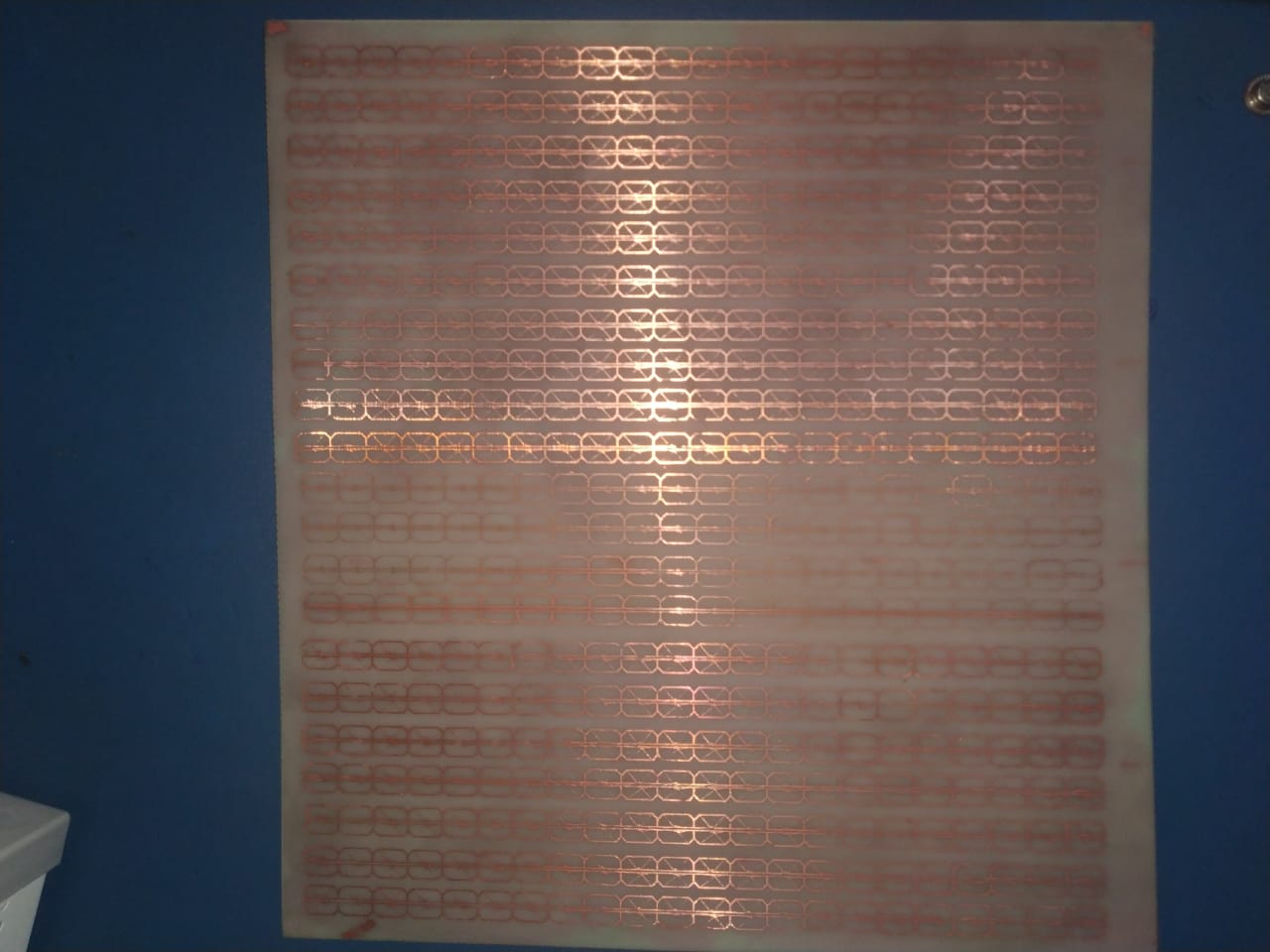
RIS with parallel capacitive setup
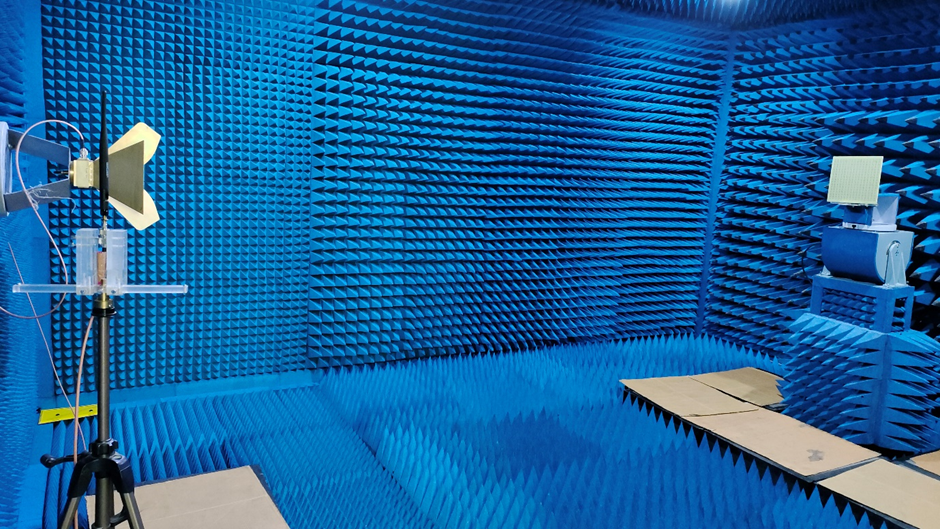
RIS testing in an anechoic chamber (set up at IIIT NR currently)
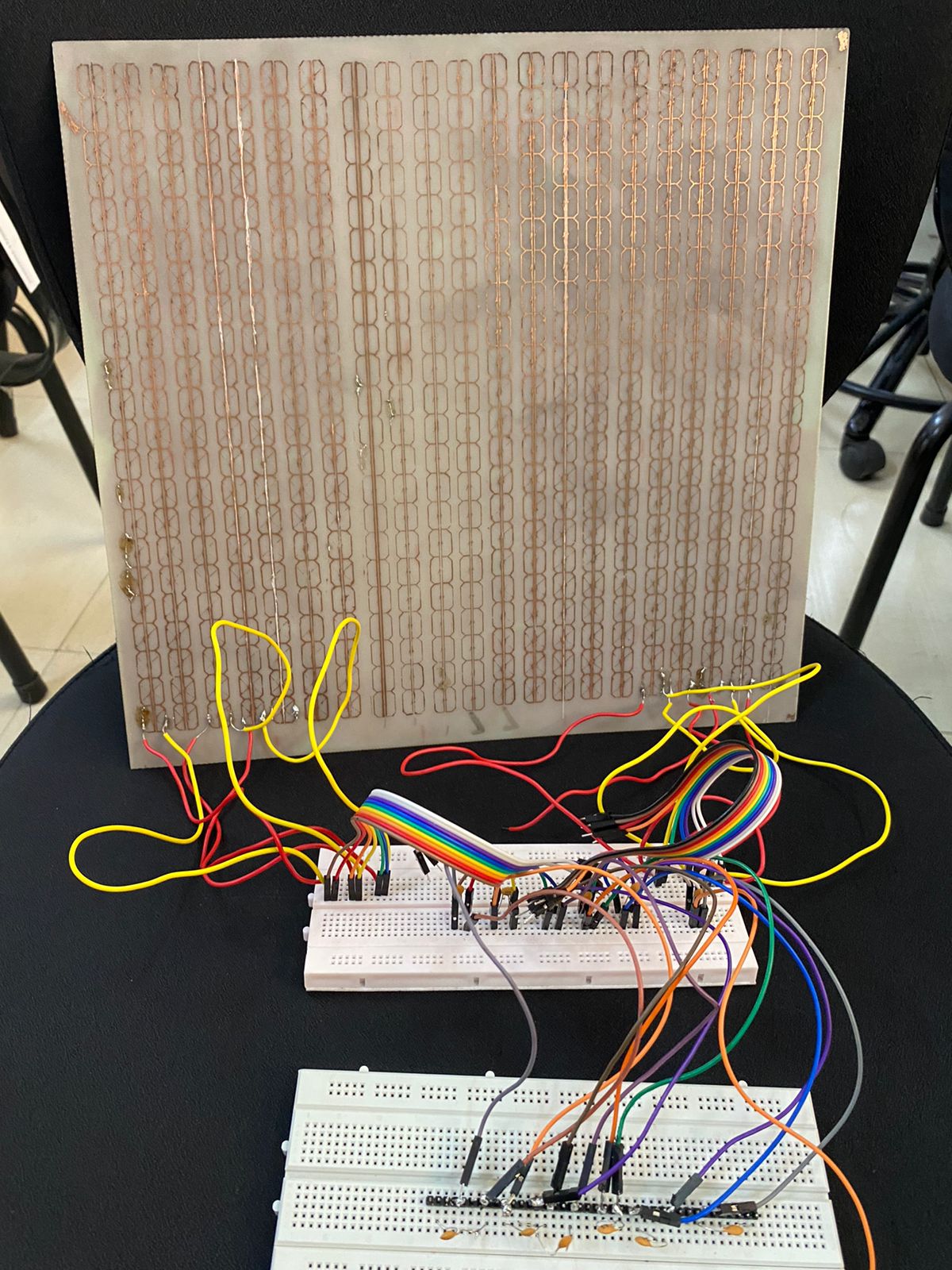
Fabricated RIS
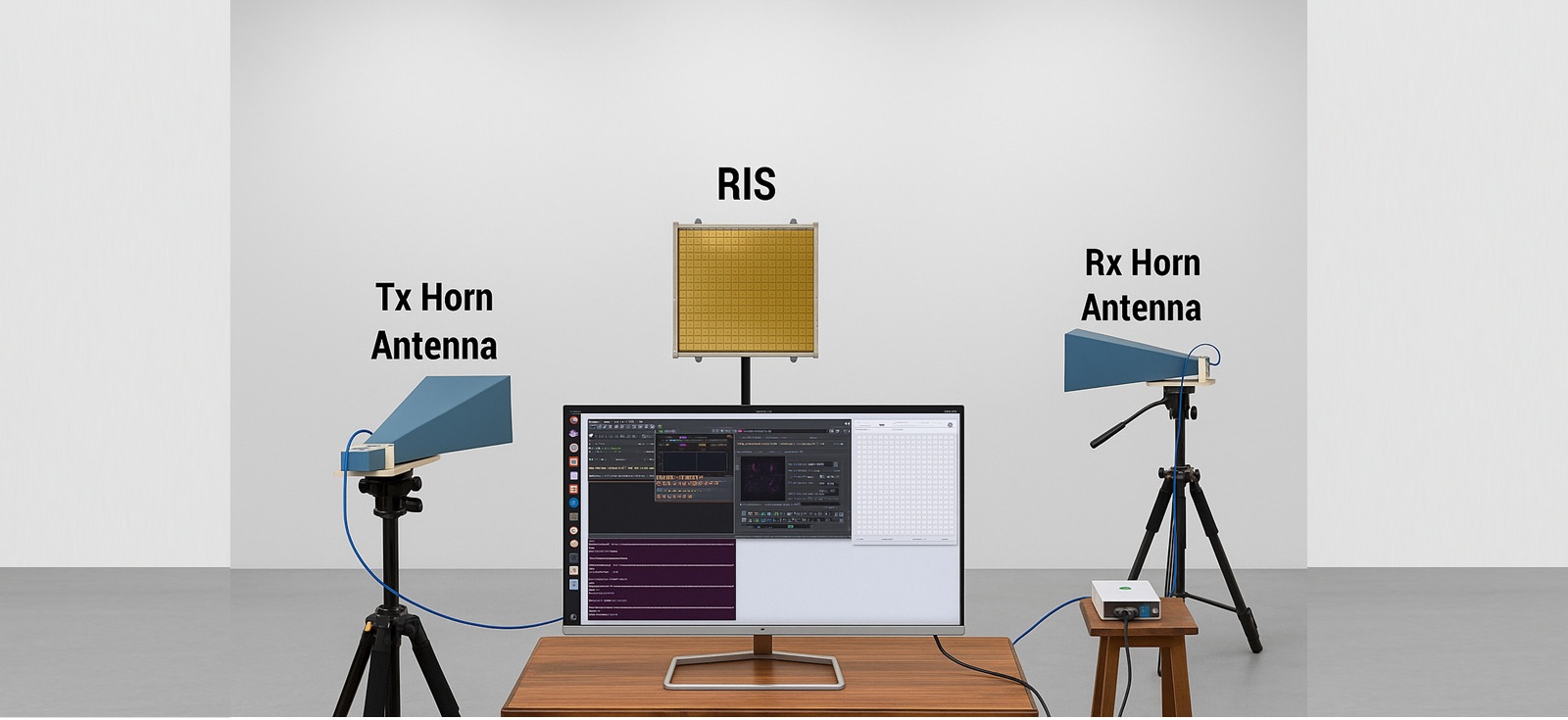
RIS Setup
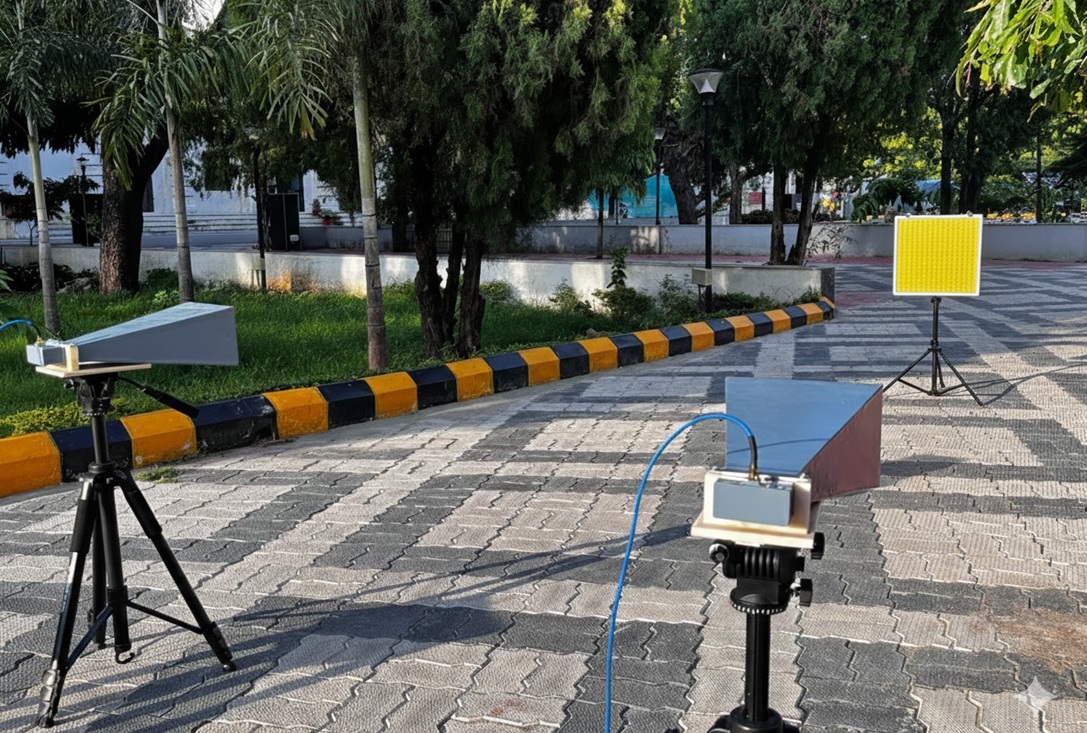
RIS Outdoor Measurements